Every trader has seen this happen. You enter the trade right. The market moves your way. Your chart looks perfect. Yet when you check your final P&L, something feels off.
It isn’t always bad timing or a wrong strike price. Most of the time, it’s fees cutting into your profits.
In crypto derivatives, where traders place dozens of positions every week, costs decide whether a strategy stays profitable or not. That’s why Delta Exchange’s low-fee model has drawn so much attention from crypto F&O traders in India.
The question is simple – does paying less on every trade really translate into more profit in your account?
This post will discuss exactly that and more about Delta Exchange – one of the top Indian crypto exchanges.
Why Trading Fees Matter in Crypto Derivatives Trading?
Crypto derivatives, especially F&O, are a high-activity driven market. Traders scalp, hedge, roll positions, and rebalance portfolios daily. Each of these actions comes with a cost.
On many exchanges, crypto derivatives fees reach as high as 0.5% per order. That might not sound huge, but when you’re trading positions worth lakhs or running multi-leg strategies, those percentages stack up fast.
Consider this:
If you trade just ₹1 lakh per position and place 10 trades in a day, a 0.5% fee means you’re paying ₹500 per trade or ₹5,000 in a single day. Over a month of active trading, that’s well over ₹1 lakh gone purely in charges.
This is why professional traders pay closer attention to the trading fees on the platform.
Where Delta Exchange Fits Into This Picture?
Delta Exchange is an Indian crypto exchange built only for derivatives. There is no spot trading here – everything revolves around futures and options.

The platform is registered under FIU India and supports INR deposits and withdrawals, and gives you access to Bitcoin, Ethereum, and dozens of altcoin contracts from a single account.
What sets Delta apart is its low trading fees compared to most other crypto platforms.
What Delta Exchange Actually Charges?
Here’s what you pay on Delta Exchange for crypto derivatives trading:
1. Futures Trading Fees
- Taker: 0.05%
- Maker: 0.02%
2. Options Trading Fees
- Taker: 0.010%
- Maker: 0.010%
On top of that:
- 18% GST applies to trading fees.
- Option fee is capped at 3.5% of the premium, so costs don’t spiral during volatile markets.
The platform does not charge any fees for withdrawals or deposits.
What Happens During Liquidation?
Delta has maintained transparency for liquidation fees:
For options:
- BTC: the lower of
- 20% of premium
- 0.05% of notional size
- ETH: the lower of
- 20% of premium
- 0.10% of notional size
For futures:
- BTC: 0.05%
- ETH: 0.10%
- Other coins scale from 0.10% to 1.00% based on leverage
18% GST applies here too – no hidden charges.
Selling BTC options as a Maker on Delta – An Example
Sell order for 500 BTC option contracts as a maker.
Each contract represents 0.001 BTC, and BTC trades at $100,000.
That makes your notional trade value:
500 × 0.001 × $100,000 = $50,000
Now let’s calculate the trading fee.
Delta charges 0.01% on options trades, so the normal trading fee would be:
$50,000 × 0.01% = $5
But there is a cap based on the option premium. With a premium of $50, the 3.5% cap comes to:
3.5% × 500 × 0.001 × $50 = $0.875
Since the cap amount ($0.875) is lower than the regular trading fee ($5), the lower value applies.
After adding 18% GST, the total fee becomes:
$0.875 × 1.18 = $1.03
So on a $50,000 BTC options trade, you pay just about $1.03 in total.
Does this change your profit over time?
Low fees don’t make you win trades, but they stop potential winning trades from turning into mediocre ones or losses.
For example, if you trade 10 times a week:
- At $30 per trade = $300 in fees
- At $1.18 per trade = $11.8
Over weeks and months, these numbers make a huge difference and shape your entire P&L. That’s why a low trading fee structure starts to matter more than most people think.
Other Delta Tools That Support Active Traders
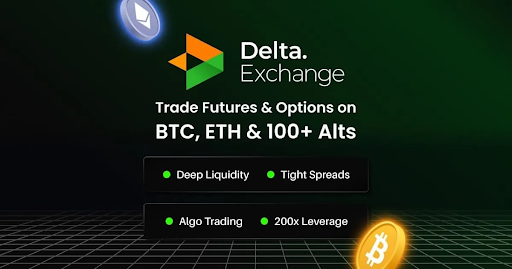
Low trading fees work best when the platform lets you trade efficiently. Delta offers:
- BTC and ETH options contracts with multiple expiries.
- Futures on 100+ altcoins with varying leverage.
- Payoff charts to preview risk and breakeven points.
- Algo trading bots and APIs for trade automation.
- Demo mode for practice without real money investment.
- Hedging and portfolio diversification for risk management.
- Up to 200× leverage – but with equally high risk of losses.
- INR-based trading without currency conversions.
All of these let you place orders, test, and manage strategies without friction.
Final Thoughts
So, does Delta’s low trading fees really help? Yes, but not because it’s cheap. But it helps by removing hidden charges on every trade and providing transparency.
If you trade crypto F&O often, the difference shows up in your P&L – quietly, consistently, and over time. That’s where real edge comes from.
To start trading crypto derivatives, visit www.delta.exchange. You can also follow Delta on X for the latest updates.
Disclaimer: Cryptocurrency markets are subject to high risks and volatility. Kindly do your own research before investing.